The MRS®, the company GPS
The Systemic Resonance Model (MRS®) is a model for diagnosing and steering organisations, created by Jérôme Lefeuvre and Pierre Agnèse. It reads every Organisation as a living system, built on three pillars, Project, Governance and Relationships, whose nine components are either in resonance or in dissonance.
- Authors
- Jérôme Lefeuvre and Pierre Agnèse
- The book
- L’Organisation Résonante, InterÉditions (Dunod), 2025; English edition in preparation
- Roots
- Transactional Analysis: Eric Berne, Stephen Karpman
- Development
- Twelve years of research and fieldwork, since 2012
An Organisation, a living system
For Jérôme Lefeuvre and Pierre Agnèse, an Organisation is “any group of individuals brought together around a common Project, in Relationship with one another and governed by a system of Governance”. The definition applies to a company, a department, a leadership team, a charity or a city.
Like any living system, an Organisation seeks balance with its environment, its purpose, its market and its talent. When its components are in tune, it is in resonance. When one of them falls out of tune, a dissonance appears: a signal from the system, not the fault of an individual.
The model works like tracing paper: we lay it over the situation a leader describes, and together we establish a diagnosis, then an action plan. The authors call it a GPS, a Guide to Piloting Systems.
“A resonant Organisation is not a perfect Organisation. It is an Organisation that vibrates in tune.”Jérôme Lefeuvre and Pierre Agnèse, L’Organisation Résonante
Three pillars, nine open doors
The MRS® looks at each pillar through three components. The authors call them “open doors”: self-evident truths that nobody disputes, and that so many organisations end up overlooking.
Project
How is your Project doing?
Vision: does your Project have a compass?
Sense: why do we do what we do?
Plan: intelligence in action.
Governance
How is your Governance doing?
Valuing: what fuel do you put in the engine?
Safeguarding: have you planned effective shields?
Powers: is anyone flying the plane?
Relationships
Are your Relationships healthy?
Volition: wanting to belong to a collective.
Solidarity: mutual support in service of the Project.
Proactivity: the unspoken spreads like a virus.
Each pillar has one component starting with P, one with S and one with V: a tribute from the authors to the three roles of the Karpman Triangle, Persecutor, Rescuer and Victim.
The nine dissonances: what you observe
Each component out of tune produces a recognisable dissonance. A leader enters the model through it: they recognise it in their own organisation.
The secret doors: reading the system
The MRS® takes its name from the mutual influence of its components. Where two pillars meet, three “secret doors” open.
Integrity
Project × Governance. The backbone: the course and the way of steering point in the same direction. The Organisation does what it says.
Trust
Governance × Relationships. The nervous system: a Governance that recognises, protects and decides with fairness calls forth the commitment of its teams.
Energy
Project × Relationships. The breath: do the leaders love the people who carry out the Project? Do those people love the Project?
In practice, the place where the alarm sounds is not the place to act. A team that no longer puts forward ideas is, as a rule, responding to a Governance that does not welcome them. The diagnosis traces the effect back to its cause.
Three reputations, seen from outside
Clients, candidates and partners perceive the imprint of the three pillars. The authors call these the “keys to the kingdom”.
Power
“They know what they are doing. They move forward. They master their subject.”
Solidity
“They stand firm. You can count on them.”
Vitality
“They are in good health. They make you want to join. Things happen there!”
Where the model comes from
Jérôme Lefeuvre and Pierre Agnèse have worked as organisational consultants for close to thirty years, in France and abroad. They are the authors of the MRS®, from its first sketch to its current form.
- Mid-2000s
Trained and certified in Eric Berne’s Organisational Theory, Berne being the founder of Transactional Analysis, they look for a model that is less dated and more grounded in reality, one their clients can make their own.
- 2007
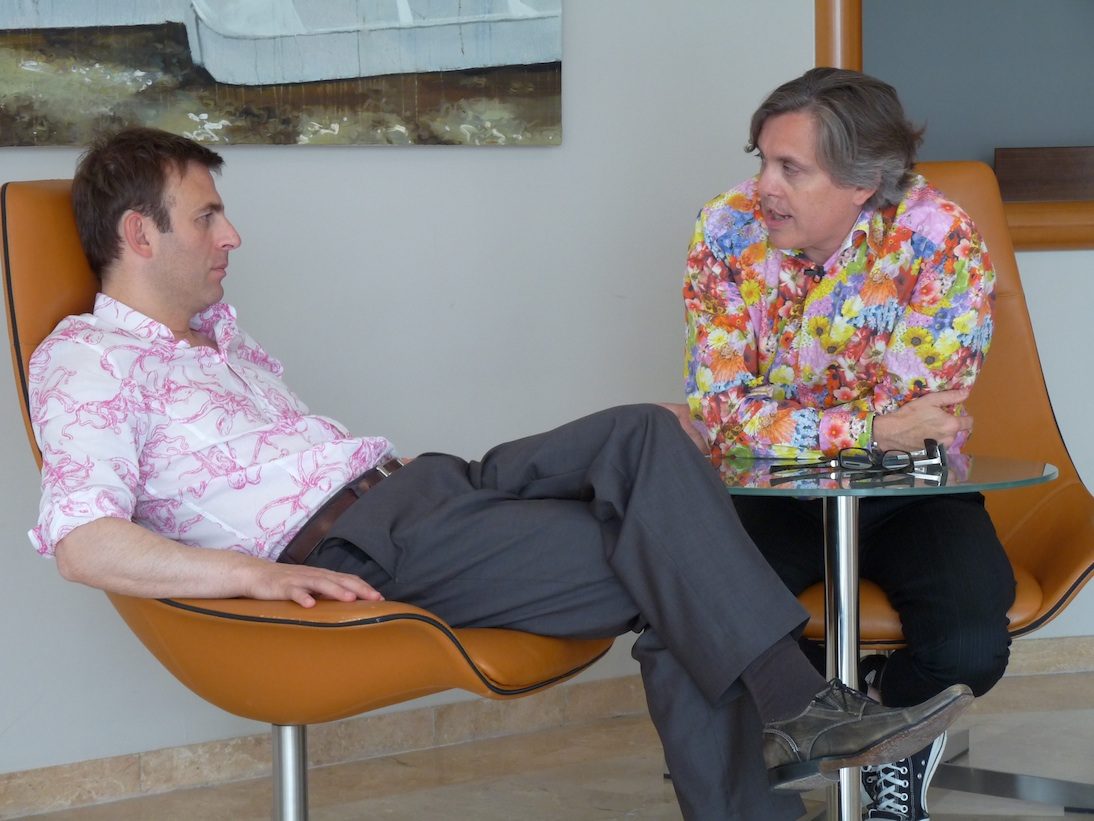
In Hot Springs, Arkansas, they meet Stephen Karpman. Working with him, they see in his Triangle a simple, clear systemic approach that matches their aim: to modernise Berne’s theory while staying within the Transactional Analysis family.
- 2012
The first intuitions of the model take shape. Twelve years of development follow: they test and refine the model in the field, and their diagnostic tool, the DRSO, serves as the research laboratory for the MRS®.
- 2025
Publication of L’Organisation Résonante. Enfonçons les portes ouvertes… de l’entreprise by InterÉditions (Dunod). An English edition is in preparation.
A case study: MUSE School, Los Angeles
A private school was emerging from several turbulent years. Its leadership team wanted to measure the school’s climate and check that its staff were behind them. An MRS® diagnosis with the staff, followed by a second measurement a few months later, revealed strong confidence in the school’s ability to weather crises, and a blind spot: the school’s vision was not clear to everyone. The leadership team made it their priority.
Diagnosing your organisation
Three ways in, depending on your time and the perspective you are looking for.
The quick diag, in 3 minutes
Nine statements on the Vision, Sense and Plan of your company. You receive three strengths, one point to watch and a lead for action.
The leaders’ seminar
One day in Paris, 1 h 30 online and an individual debrief: you learn the MRS® and carry out the diagnosis of your own organisation, among peers. Held in French.
Support for your leadership team
Jérôme Lefeuvre runs the diagnosis with your teams, then the working sessions on the priorities you approve, in English or in French.
Let’s talk about your organisation
Thirty minutes, with no commitment, to set out your situation and choose the right way in for you.
Further reading
- The Resonant Organisation (L’Organisation Résonante)Jérôme Lefeuvre and Pierre Agnèse, InterÉditions (Dunod), 2025. The reference book on the MRS®, with its method sheets (in French; English edition in preparation).
- Three Essential Questions for Any Leadership Team Worth Its SaltArticle on Vision, Sense and Plan
- The Unspoken Is a VirusArticle on Relational Proactivity
- Leadership teamsHow Jérôme Lefeuvre works with leadership teams, step by step
Your questions about the MRS®
What is the Systemic Resonance Model?
A model for diagnosing and steering organisations, created by Jérôme Lefeuvre and Pierre Agnèse. It looks at every Organisation as a living system, through three pillars, Project, Governance and Relationships, and nine components that are either in resonance or in dissonance.
Who created the MRS®?
Jérôme Lefeuvre and Pierre Agnèse, organisational consultants. They developed it over twelve years of research and fieldwork, in the tradition of Eric Berne’s and Stephen Karpman’s Transactional Analysis. They present it in L’Organisation Résonante (InterÉditions, 2025); an English edition is in preparation.
What are the nine components of the MRS®?
For the Project: Vision, Sense, Plan. For Governance: Valuing, Safeguarding, Powers. For Relationships: Volition, Solidarity, Proactivity.
What is a dissonance?
The signal of a component out of tune: the Void, Stress, Passivity, Vanity, Sabotage, Partiality, Victimhood, the Saviour or Percussion. The MRS® reads it as the logical response of the system, not as the fault of an individual.
How is the MRS® linked to the Karpman Triangle?
The authors designed the model while working with Stephen Karpman. The components carry the initials P, S and V as a tribute to his Triangle, and the Relationships pillar draws on its virtuous version.
How can I diagnose my organisation with the MRS®?
Start with the online quick diag, which covers the Project pillar. For a full diagnosis, book a call with Jérôme Lefeuvre: he supports leadership teams in English or in French.
Source: Jérôme Lefeuvre and Pierre Agnèse, L’Organisation Résonante. Enfonçons les portes ouvertes… de l’entreprise, InterÉditions, 2025, ISBN 978-2-7296-2313-5.

Comments are closed.